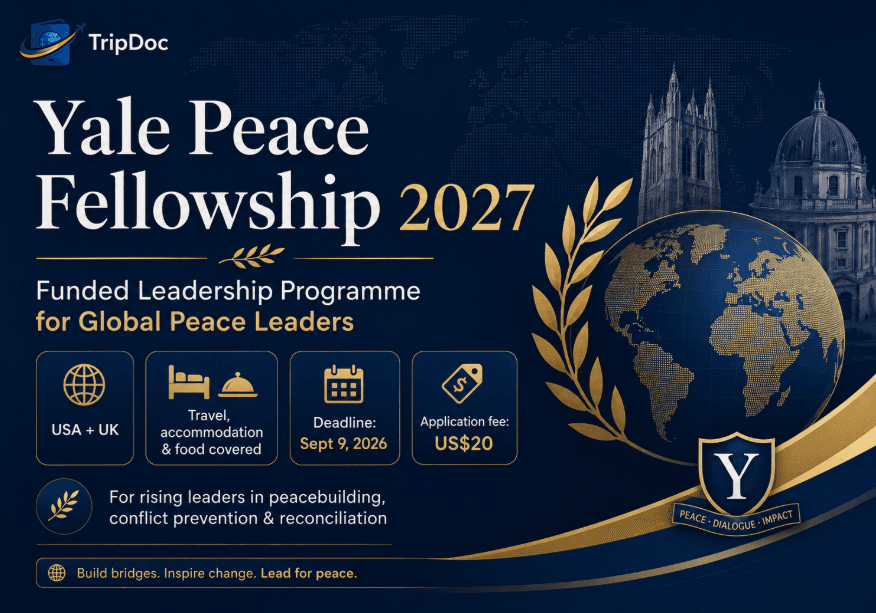
The Yale Peace Fellowship is an international leadership development programme hosted by the International Leadership Center at the Yale Jackson School of Global Affairs.
It brings together rising leaders who are working on the frontlines of conflict prevention, peacebuilding and post-conflict reconciliation.
The fellowship is intended to strengthen participants’ leadership abilities, deepen their understanding of contemporary conflict and connect them with peace leaders, international experts and practitioners from different countries and professional sectors.
The 2027 programme combines virtual sessions with two in-person convenings in the United States and the United Kingdom.
Programme Dates and Locations
Yale University Convening
Location: Yale University, New Haven, Connecticut, United States
Dates: April 12–16, 2027
Virtual Sessions
Interactive virtual sessions will take place bi-weekly from March through June 2027.
Rose Castle Convening
Location: Rose Castle, United Kingdom
Dates: June 14–18, 2027
Applicants must be available to participate fully in every part of the programme.
Who Can Apply?
The official Yale application page does not state a nationality restriction.
Applicants from different countries may therefore apply, provided they meet the professional and leadership requirements.
Be available for the virtual sessions and both in-person convenings.
Be able to demonstrate meaningful work in conflict prevention, peacebuilding or post-conflict reconciliation.
Professional Backgrounds
Yale states that fellows may come from a variety of professional sectors, including:
Civil society.
Diplomacy.
Politics.
Religious leadership.
Social enterprise.
Conflict prevention.
Peacebuilding.
Reconciliation and community development.
The programme is not limited to applicants from one profession.
Benefits
Selected fellows will receive:
A week-long in-person seminar at Yale University.
A second in-person convening at Rose Castle in the United Kingdom.
Interactive virtual sessions from March to June 2027.
Negotiation and leadership training.
Opportunities to learn from international experts.
Structured time to reflect on modern conflict.
Connections with a global network of peace leaders.
Membership in a growing fellowship network.
Covered travel costs connected with the in-person programme.
Covered accommodation.
Covered food and programme-related participation costs.
Funding Clarification
Yale states that costs connected with participation in the in-person programme—including travel, accommodation and food—will be covered.
However, the public application page does not provide:
A fixed cash stipend amount.
A salary.
A monthly allowance.
Funding for dependants.
Funding for family members.
A personal research grant.
A relocation allowance.
Therefore, TripDoc should classify the opportunity as a funded fellowship programme, not as a salaried fellowship.
Eligibility
Strong applicants should be able to provide evidence of:
Direct experience in peacebuilding or reconciliation.
Leadership in an organisation, initiative, movement, institution or community.
Measurable professional or community impact.
Experience working across cultural, religious, political or social differences.
The ability to communicate professionally in English.
Potential to contribute meaningfully to the fellowship cohort.
Availability for the entire programme.
Degree Requirement
The official application page does not list a required bachelor’s, master’s or doctoral degree.
Therefore, TripDoc should not invent an academic qualification requirement.
Selection appears to focus primarily on professional accomplishment, leadership and peacebuilding impact.
Age Requirement
The official application page does not state a minimum or maximum age.
TripDoc should not advertise this as an opportunity for a particular age group unless Yale later publishes an age requirement.
Required Documents
Applicants must submit:
A résumé or curriculum vitae of no more than three pages.
A brief video statement.
A personal statement of no more than 600 words.
One letter of recommendation.
The US$20 electronic application fee.
Applicants should create their online account early so they can review the exact video instructions and request the recommendation letter before the deadline.
Personal Statement Guidance
The official public page confirms a maximum length of 600 words but does not publish the complete essay prompt on the public page.
Applicants should answer the exact question displayed inside the application portal.
A competitive statement should demonstrate:
The conflict or peacebuilding problem the applicant addresses.
The applicant’s specific role.
Evidence of leadership and measurable impact.
Challenges faced and lessons learned.
Why the Yale Peace Fellowship is relevant now.
What the applicant will contribute to the cohort.
How the applicant will use the fellowship after completing it.
Applicants should avoid writing a generic essay about wanting world peace.
Video Statement Guidance
A brief video statement is required.
The complete technical instructions should be checked inside the application portal.
Applicants should:
Follow the exact time limit.
Answer the stated prompt directly.
Use clear audio and adequate lighting.
Speak naturally rather than reading an entire script.
Provide concrete examples of leadership and impact.
Avoid repeating the personal statement word for word.
I cannot confirm the exact video duration from the publicly accessible programme page.
Recommendation Letter
One recommendation letter is required.
The strongest recommender will normally be someone who can provide specific evidence of the applicant’s:
Leadership.
Peacebuilding work.
Professional integrity.
Cross-cultural competence.
Influence and measurable contribution.
Readiness for an international leadership programme.
Applicants should not choose a recommender solely because the person has a prestigious title.
A detailed recommendation from someone who knows the applicant’s work is usually stronger than a generic letter from a famous person.
Application Steps
Read the official programme description and eligibility criteria.
Confirm that you have substantial peacebuilding or reconciliation experience.
Create an account through the official Yale application portal.
Review all questions and video instructions.
Prepare a CV or résumé of no more than three pages.
Draft the personal statement within the 600-word limit.
Record and upload the required video statement.
Request one recommendation letter early.
Check that the recommendation has been received.
Pay the US$20 electronic application fee.
Review every application section.
Submit at least 24 hours before the deadline.
Save the submission confirmation.
Important Warnings
This is not a Yale degree or university admission offer.
It is not a scholarship for undergraduate or graduate study.
It is not designed for applicants with only an interest in peacebuilding and no evidence of work or impact.
The fellowship is highly competitive.
There is a US$20 application fee.
Funding for programme participation does not mean fellows receive a salary.
Applicants must attend both in-person components.
Applicants may need permission from their employer or organisation.
Dependants and accompanying family members are not listed as funded.
Selection does not automatically guarantee a US or UK visa.
Applicants should use only the official Yale application portal.
No legitimate person can guarantee selection in exchange for payment.
Visa Support
Selected fellows will need to travel to:
The United States for the Yale convening.
The United Kingdom for the Rose Castle convening.
Yale confirms that travel and other programme participation costs will be covered.
“International travel is funded, but visa approval is not guaranteed. Selected fellows should follow Yale’s instructions regarding travel documentation and visa support.”
Application Fee Warning
The required US$20 fee should be paid only through the official application system.