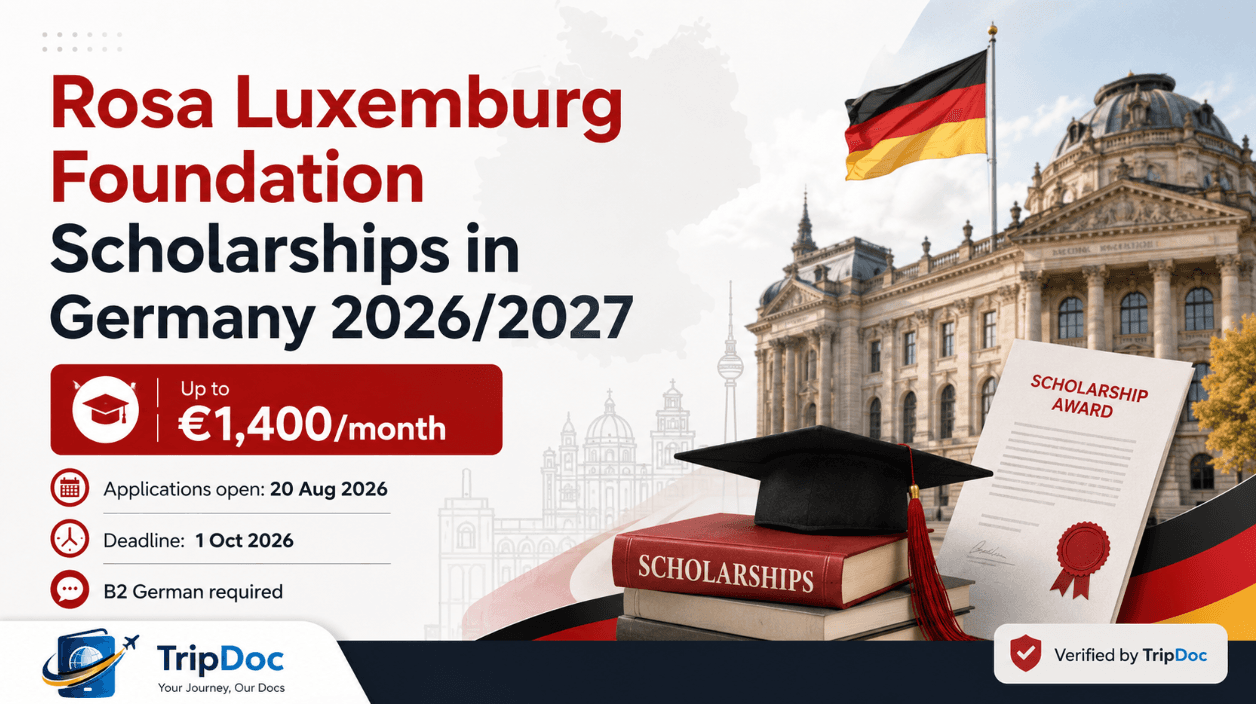
Verified guide to the Rosa Luxemburg Foundation Scholarships in Germany for international Master’s and PhD applicants. Check funding, B2 German requirements, documents, eligibility, opening date and the 1 October 2026 deadline.
Who can apply?
International Master’s-level applicants
Applicants generally must:
•Be foreign nationals.
•Be admitted to or enrolled at a state or state-recognised German university.
•Have completed a bachelor’s degree or equivalent undergraduate study.
•Show excellent academic performance.
•Demonstrate meaningful political or social engagement.
•Provide German-language evidence at B2 level.
•Be in Germany for study purposes.
•Meet the Foundation’s residence-duration rules.
•Not qualify under the Foundation’s domestic BAföG-based category.
The programme is not a general overseas scholarship through which applicants apply first and later seek admission. Admission or enrolment in Germany is a core requirement.
•Be admitted for a doctorate at a German university or undertake a supervised doctoral research stay in Germany.
•Have a university supervisor in Germany where required.
•Have an excellent academic record.
•Demonstrate social engagement aligned with the Foundation.
•Provide B2 German-language evidence, even where the dissertation is written in English.
•Normally not have spent more than 15 months in Germany at the time of application, subject to the official exceptions.
•Avoid prohibited double funding from other public sources.
Benefits
International study scholarship
•Current monthly base scholarship: €934
•Possible additional supplements
•Funding normally follows the programme’s standard study duration
•Access to seminars, workshops, advice, networking and political education
•No simultaneous funding from other public sources
International doctoral scholarship
•Current monthly base stipend: €1,400
•Mobility allowance: €100 per month
•Additional flat-rate benefit: €20 per month
•Maximum funding for a doctorate at a German university: generally up to three years
•Possible support for academic research stays and conferences, subject to the programme rules
Eligible disciplines
The doctoral programme covers most academic fields.
Medical disciplines are excluded. The official page refers broadly to medical disciplines rather than presenting the third-party article’s longer, independently categorised list. Use the official wording to avoid overclaiming.
Required documents for international students
The official 2026 document page lists:
•Enrolment certificate for winter semester 2026/2027, showing the programme and completed - university semesters, or a current admission letter if enrolment is not yet available.
•Chronological CV in German or English.
•Evidence of social or political engagement.
•Academic assessment or recommendation from a lecturer, professor or university teacher.
•Evidence of the highest completed qualification, including the final grade.
•Current German-university transcript or performance record, where available.
•Extract from the study regulations showing the programme’s standard duration.
•Passport or identity document.
•German visa or residence permit for non-EU applicants.
•German-language proof at B2 level.
Language-document exception
Where B2 certification is not yet available by the deadline, the official document page says a current B1 certificate plus proof of enrolment in an ongoing or soon-to-begin B2 course may be accepted at the application stage. That is not the same as saying B1 alone satisfies the final language requirement.
Application steps
1.Confirm whether you qualify for the international study or international doctoral programme.
2.Secure admission or enrolment at an eligible German institution.
3.Gather your academic records.
4.Obtain evidence of social or political engagement.
5.Request your academic recommendation early.
6.Prepare B2 German-language evidence or the permitted interim documents.
7.Scan each requested document as a separate PDF.
8.Open the official application page on or after 20 August 2026.
9.Complete the German-language online application.
10.Submit everything by 1 October 2026 at 23:59.
Selection process
The official process includes:
•Formal eligibility review.
•Internal preselection.
•Academic or trustee assessment and interview.
•Final selection committee decision.
•Notification by email.
•Mandatory introductory seminar for selected scholars.
Important warnings
•Do not apply by email or post.
•The online application system is primarily in German.
•B2 German is a serious condition, not a minor preference.
•English-taught programmes do not automatically waive the German requirement.
•International bachelor’s study is not covered by the international study-scholarship category.
•Scholarship selection is highly competitive.
•University admission and scholarship selection are separate processes.
•The scholarship does not automatically provide a visa.
•Do not pay an agent to “guarantee” selection.
•Public double funding is generally prohibited.
•A scholarship application cannot replace the university application.
•Applicants should document genuine, sustained engagement; merely writing that they “care about society” will not be persuasive.
Visa support
No direct visa sponsorship is stated.
A scholarship award may support a student’s financial evidence, but the applicant remains responsible for securing the correct German visa or residence permit. The 2026 document list asks non-EU applicants to provide a visa or residence permit and states that a mere provisional residence certificate may not be sufficient in the specified context.
Application fee
I cannot confirm any application fee because the official scholarship pages reviewed do not state one.